This one is a pretty interesting story I thought I'd share from a find I had a while back and one of the fun experiences I've had collecting Maglites. My dad and I have collected other antiques as well as classic trucks and guns for a long time. Over time we've built up a pretty good network and frequent estate sales, flea markets, garage sales, you name it! A few months ago we got a call from a seller who was liquidating a police equipment store that closed in the 80s in Virginia. The entire store was packed away into a storage locker until the owner passed away.
There were several Maglites in the storage locker. Most of the lights were 1990 transitional models. They are the ones in the 5 hang packs with the horizon logos below. These are rare when new in box but not super desirable among collectors. The real gem of those is the 5C. The 5 and 6Cs were discontinued in 2003 and are very rare because they were so unpopular when new. They are pretty well sought after now and I've detailed them here. The other two lights are a display box 2D from 1988 and a white display box 2C from 1984. The 1984 light has the old rounded style Maglite logo. Lights in this package are next to impossible to find new in box because of their age. The white cardboard display boxes are super durable though and very heavy.
Another interesting note on these packages is the statement on the back that Maglite has a trademark on the circumferential inscription around the bezel as shown below. This means no one else is allowed to print words around the bezel of a flashlight. This trademark was applied for in 1988 and granted in 1993. During that time Maglite sent several cease and desist letters to other manufacturers using this design. Streamlight and Brinkmann were 2 notable examples. Brinkmann made an almost identical Mini Maglite, often referred to as a "lawsuit light" and was subject to huge penalty's in the mid 80s that almost put them out of business. Streamlight used a similar focus system on D cell lights and a laser etching on the bezel of their Excaliber line that said Spot >>> <<< Flood in white lettering to denote which way to turn the head of the light. I've done a small write up on these lights on my other flashlight blog which can be found here. It should be noted that as far as I can tell Maglite was the first flashlight to use words printed around the bezel and I would certainly say that is a trademark of a Maglite flashlight and could easily confuse consumers looking for a light.
It's also interesting to note that the price on the 2C is $22 as shown below. If you lookup a 2C on Amazon as of the posting date you'll see the price is still only $22. To me this is pretty amazing because how many other things can you think of that have stayed the same price since 1984. Maglite has a long history of not raising prices on their lights and instead finding manufacturing efficiencies. I've covered some of this at the end of this post.
I didn't need doubles of the 5Ds especially considering they weren't that rare. I almost never sell lights but I love to trade. One of these lights I traded to another collector and the second I sold to a Prop Master working on the AMC TV series Halt and Catch Fire. I did a short post about that light along with some stills from the scene.
As always I'm looking to buy Vari-Beams and Vintage/Rare Mags. Please let me know if you have any, top dollar paid.
Friday, July 7, 2017
Tuesday, July 4, 2017
Switch Removal and Stuck Switches
This is part of a series of posts I've written about common Maglite repairs. I've also covered the following topics:
Removing Battery Corrosion and Straightening Bent Lights
Stuck End Caps
Stuck Batteries
Stuck Retaining Rings
Switch Disassembly and Repair
Disclaimer: I'll start out by saying that these repairs are tedious and challenging. It is very rewarding to make an old Maglite light again though. If you have a special light and don't feel up to the challenge I do restorations and custom work on most vintage flashlights. My contact info is at the right side of the page.
When a Maglite fails to light it is usually an issue with battery corrosion or a switch malfunction. The first step is trying new batteries. Once the batteries are out and the end cap is off you may find that the switch is not easily removed.
Switch removal on a working Maglite is fairly easy. Videos are available all over online but basically you'll have to remove the switch cover (it just pulls off), and then insert either a 5/64" hex key down through the switch as shown below or Mag Instrument's proprietary torx key. (C Cells use a 1/16" hex key) Only lights made after 2010 or so have the proprietary torx screw installed from the factory and all 1992+ letter serial replacement switches now use them. Mag Instrument includes the torx key with new replacement switches. As far as I know that's the only way to get a key. Standard torx keys do not fit. Earlier D cells all use a 5/64" hex key and C cells all use a 1/16" hex key.
Most of the time this is where the trouble begins. Often, the screw will not turn and the hex key just twists or strips the screw. If the screw backs out, the switch can be slid out through the back of the light or the retaining ring (pre 92) or clip (92+) can be removed and the switch can be slid out of the front of the light. If the aluminum retaining ring cannot be removed on the pre 1992 lights proceed here but you'll have to remove the switch first.
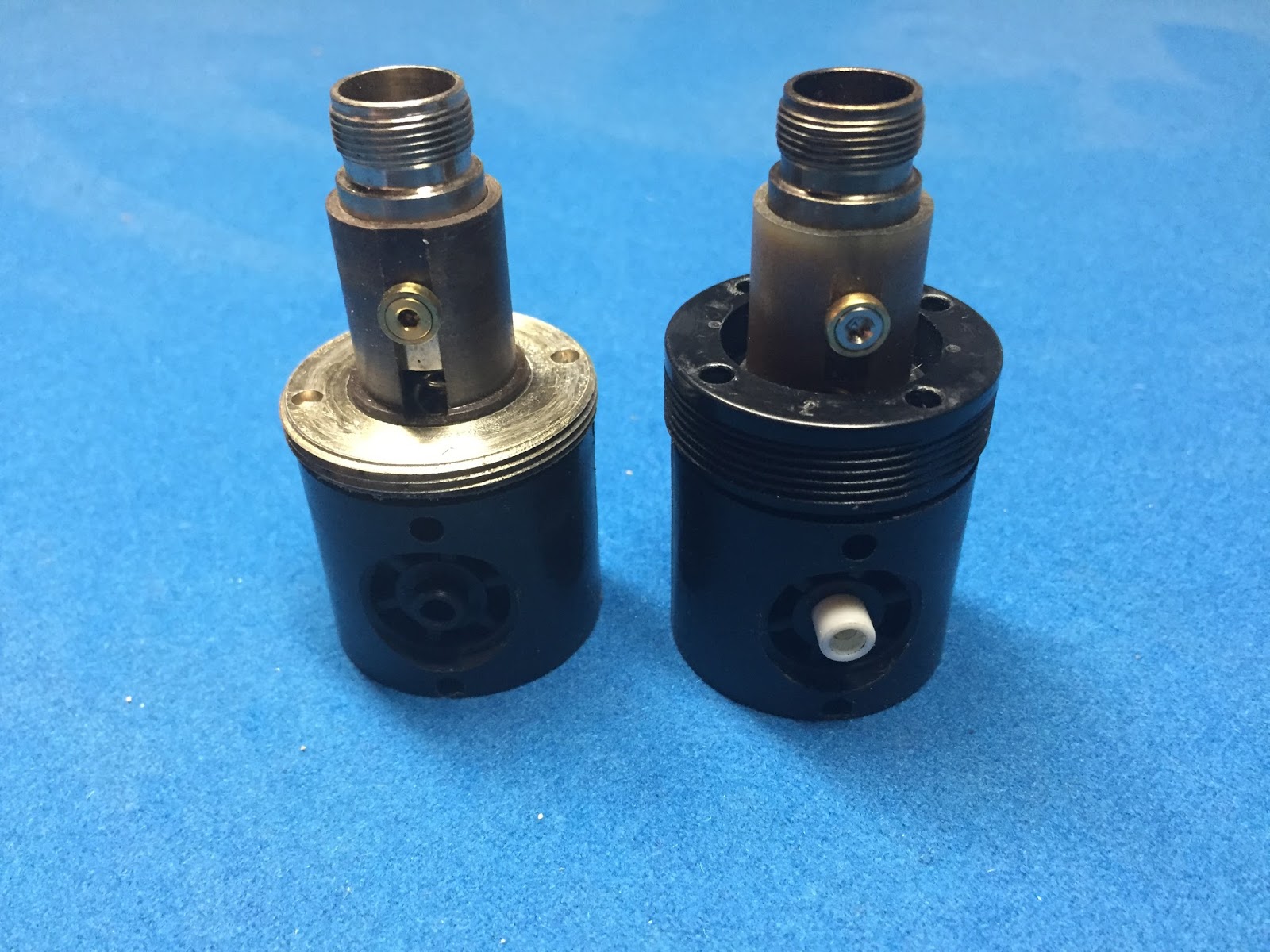
So, what to do? You can try soaking the whole assembly in vinegar to dissolve the corrosion but it will also rust the steel innards of the switch. I've not found it to be effective in removing the switch anyway. The only way I've found to remove the switch also involves rendering it useless. The only thing that holds the switch into the light is the negative terminal screw that is under the switch button. It sits into a dimple machined into the body which completes the negative side of the circuit through the body and holds the switch into the light. The idea is to remove the pressure on this screw since it won't loosen. Drilling through the plastic switch is the only way I've found to accomplish this. Please see below for pictures post drilling of the switch assembly.
I usually drill and then try to drive it through with a piece of wood or bass punch. You have to be careful not to drive it too hard or the dimple machined into the body could be ruined. Once you've drilled out enough material the switch should be easy enough to push through. Be careful not to drill into the body either. The picture below shows the corrosion around the negative terminal screw that wasn't allowing it to turn.
As always I'm looking to buy Vari-Beams and Vintage/Rare Mags. Please let me know if you have any, top dollar paid.
Removing Battery Corrosion and Straightening Bent Lights
Stuck End Caps
Stuck Batteries
Stuck Retaining Rings
Switch Disassembly and Repair
Disclaimer: I'll start out by saying that these repairs are tedious and challenging. It is very rewarding to make an old Maglite light again though. If you have a special light and don't feel up to the challenge I do restorations and custom work on most vintage flashlights. My contact info is at the right side of the page.
____________________________________________________________
When a Maglite fails to light it is usually an issue with battery corrosion or a switch malfunction. The first step is trying new batteries. Once the batteries are out and the end cap is off you may find that the switch is not easily removed.
Switch removal on a working Maglite is fairly easy. Videos are available all over online but basically you'll have to remove the switch cover (it just pulls off), and then insert either a 5/64" hex key down through the switch as shown below or Mag Instrument's proprietary torx key. (C Cells use a 1/16" hex key) Only lights made after 2010 or so have the proprietary torx screw installed from the factory and all 1992+ letter serial replacement switches now use them. Mag Instrument includes the torx key with new replacement switches. As far as I know that's the only way to get a key. Standard torx keys do not fit. Earlier D cells all use a 5/64" hex key and C cells all use a 1/16" hex key.
Most of the time this is where the trouble begins. Often, the screw will not turn and the hex key just twists or strips the screw. If the screw backs out, the switch can be slid out through the back of the light or the retaining ring (pre 92) or clip (92+) can be removed and the switch can be slid out of the front of the light. If the aluminum retaining ring cannot be removed on the pre 1992 lights proceed here but you'll have to remove the switch first.
So, what to do? You can try soaking the whole assembly in vinegar to dissolve the corrosion but it will also rust the steel innards of the switch. I've not found it to be effective in removing the switch anyway. The only way I've found to remove the switch also involves rendering it useless. The only thing that holds the switch into the light is the negative terminal screw that is under the switch button. It sits into a dimple machined into the body which completes the negative side of the circuit through the body and holds the switch into the light. The idea is to remove the pressure on this screw since it won't loosen. Drilling through the plastic switch is the only way I've found to accomplish this. Please see below for pictures post drilling of the switch assembly.
I usually drill and then try to drive it through with a piece of wood or bass punch. You have to be careful not to drive it too hard or the dimple machined into the body could be ruined. Once you've drilled out enough material the switch should be easy enough to push through. Be careful not to drill into the body either. The picture below shows the corrosion around the negative terminal screw that wasn't allowing it to turn.
As always I'm looking to buy Vari-Beams and Vintage/Rare Mags. Please let me know if you have any, top dollar paid.
Sunday, July 2, 2017
1990 3D Laser Etched Chevron Light
Summary: Maglite started laser etching lights in 1988 but didn't start accepting custom laser etched orders until around 1990. This is one of the first custom laser etchings and it was done for a Chevron refinery near Maglite's headquarters.
For you viewing pleasure is a professional Maglite that's not a cop light! Starting in 1990 when Maglite changed the grip size and went to a laser etched bezel on the D cells they also started doing custom laser engraving on a per order basis. There are tons and tons of custom orders that were intended as giveaways and promotional items and it's almost impossible to collect them all. The laser engraving is much rarer on the C and D cells than on the Mini Mags and Solitaires. The reason being was that Mag had minimum order numbers on laser engraved lights, usually around 100 or so. The D and C cells were much more expensive and as such not many companies wanted to shell out that much money for giveaways and promotional items.
I love professional lights, especially ones with a good story behind them. This D cell was done as part of a large batch for Chevron intended to be used by maintenance workers at their refineries. As stated on the barrel and to deter theft it was labelled as the property of Chevron and was used in their El Segundo refinery just south of LAX. I worked in petroleum for a long time and knew a bunch of folks at Chevron. I collected a lot of petroleum items during my time in that field so this goes well with that collection and my Maglite collection. The original owner was a longtime refinery employee that took the then outdated light with him when he retired. Not having much of a use for it in recent years he sold it. I imagine most of the rest of these lights were discarded after years of use.
This light is a 4,000,000 serial 3D and a "transitional" model, one with a reduced grip sized and laser etched bezel but still with the bigger barrel and non-letter serial. These models were produced only in 1990 and 1991. It is likely one of Mag's first batches of custom laser etched orders seeing as how close Chevron is to their factory.
It is also interesting to note that Chevron has a long storied history as well. Just like the company I worked for they are a spin off of the Standard Oil Company headed up by John D. Rockefeller and were once known as Standard Oil of California before companies in the US were prohibited from using the Standard name. There are many other former Standards like Exxon (Standard Oil of New Jersey), Mobil (Standard Oil of New York), and the old Amoco (Standard Oil of Indiana). I'm really interested in the history of different companies so I thought this might be of some interest to others out there too.
The other custom laser etched C cell lights I've frequently seen are the ever popular Chevy Trucks C cells which were supplied with a tool kit on Chevy Suburbans and Tahoes. I've also seen several D and C models done for railroads too. If you have an interesting laser etched C or D cell I'd love to see it because I don't know of many.
As always I'm looking to buy Vari-Beams and Vintage/Rare Mags. Please let me know if you have any, top dollar paid.
For you viewing pleasure is a professional Maglite that's not a cop light! Starting in 1990 when Maglite changed the grip size and went to a laser etched bezel on the D cells they also started doing custom laser engraving on a per order basis. There are tons and tons of custom orders that were intended as giveaways and promotional items and it's almost impossible to collect them all. The laser engraving is much rarer on the C and D cells than on the Mini Mags and Solitaires. The reason being was that Mag had minimum order numbers on laser engraved lights, usually around 100 or so. The D and C cells were much more expensive and as such not many companies wanted to shell out that much money for giveaways and promotional items.
I love professional lights, especially ones with a good story behind them. This D cell was done as part of a large batch for Chevron intended to be used by maintenance workers at their refineries. As stated on the barrel and to deter theft it was labelled as the property of Chevron and was used in their El Segundo refinery just south of LAX. I worked in petroleum for a long time and knew a bunch of folks at Chevron. I collected a lot of petroleum items during my time in that field so this goes well with that collection and my Maglite collection. The original owner was a longtime refinery employee that took the then outdated light with him when he retired. Not having much of a use for it in recent years he sold it. I imagine most of the rest of these lights were discarded after years of use.
This light is a 4,000,000 serial 3D and a "transitional" model, one with a reduced grip sized and laser etched bezel but still with the bigger barrel and non-letter serial. These models were produced only in 1990 and 1991. It is likely one of Mag's first batches of custom laser etched orders seeing as how close Chevron is to their factory.
It is also interesting to note that Chevron has a long storied history as well. Just like the company I worked for they are a spin off of the Standard Oil Company headed up by John D. Rockefeller and were once known as Standard Oil of California before companies in the US were prohibited from using the Standard name. There are many other former Standards like Exxon (Standard Oil of New Jersey), Mobil (Standard Oil of New York), and the old Amoco (Standard Oil of Indiana). I'm really interested in the history of different companies so I thought this might be of some interest to others out there too.
The other custom laser etched C cell lights I've frequently seen are the ever popular Chevy Trucks C cells which were supplied with a tool kit on Chevy Suburbans and Tahoes. I've also seen several D and C models done for railroads too. If you have an interesting laser etched C or D cell I'd love to see it because I don't know of many.
As always I'm looking to buy Vari-Beams and Vintage/Rare Mags. Please let me know if you have any, top dollar paid.
Monday, June 26, 2017
Service Kits and Service Centers
Summary: Maglite used to operate a large dealer and service network that has recently ceased operations. These dealers and service centers were primarily based out of small hardware, sporting goods, and law enforcement supply stores. They were well trained in service and sales techniques.
Starting with Maglite's founding in 1979 and up until 2015 Mag Instrument supported third party service centers in almost every state. This was the norm when aluminum flashlights first appeared in the early 70s. A 2D Maglite has been consistently priced at around $26. This is equal to almost almost $100 in 2017 dollars so in the early 80s most users considered these lights a sizable investment that they wanted to keep in good running order.
Maglites have always had a lifetime warranty and very rarely are they prone to failure. Mag Instrument has never covered battery leakage though and that is where most faults occur. The switch mechanism occasionally wears and fails or the seals fail and moisture is introduced to the mechanism which results in a high resistance where the bulb will fail to light. I have a post about repairing and diagnosing switches because they can be easily fixed rather than replaced with a little know how. Lenses, switch seals, reflectors and o-rings could also be tuned up on a routine service visit.
During Mag's early days Don Keller mostly went on the road to setup these service centers. Originally Maglite took some of their larger dealers, mainly hardware, sporting goods, and police equipment stores, at about one per state with the exception of Alaska and Hawaii, and trained designated employees on how to service Maglites. The service center was also able to purchase service kits as shown below. (The Maglite is for display only. It's a 1984 3D light I'm working on restoring for another Maglite fan.) Warranty repairs were reimbursed by Maglite at an appropriate rate and normal wear and tear like o-rings and lenses were billed out as per the price list below plus whatever markup the dealer desired. 20% as noted in this case.
This service kit came from a closed Maglite service center. The paperwork with it has the pre-1984 Maglite logo which means it was from one of the earliest service centers setup by Maglite. This particular service kit came from a closed gun dealer / gun smith in Missouri. Most of the items listed on the supply sheet are present as shown below but it has no lenses which gives some insight as to which parts wear first. It does have extra of almost every other item including switches, which is mainly what I was after. These switches are the older style aluminum retaining ring ones. I've discussed the drawbacks of these switches in my post on restorations but I still like to use them for restorations to keep the light period correct. Also shown below is a scan of the small service manual that was included with these kits intended as a reference for the training that was provided.
Included in this kit is also the older style Maglite spanner tool. This tool is far superior to the current plastic one. Most retaining rings come out fairly easily and can even be removed with needle nose pliers as a makeshift spanner but some of the more stubborn ones cause the dowels in the plastic tool to yield the plastic they are housed in and fall out. As far as I know these older aluminum style spanner wrenches are long out of production. the original part # was MSLC-52 but Mag Instrument no longer uses this numbering scheme. The part number for the new spanner wrench is 112-000-001 and is still available for order. Shown below is the new spanner tool vs. the old machined aluminum one.
The tools are pretty neat in that it has a C cell wrench on one end and a D cell wrench on the other. The picture on the left above shows the D cell end and the picture on the right shows the C cell end.
I also have another, newer style, service kit from a now defunct distributor in California. This service kit is from 1995 as noted in the literature that came with it. It comes with parts for both the letter serial (panther), and non-letter serial lights and the maintenance manual notes the differences as well. It is mostly complete and the Maglite part number can even be seen on the side of the box. The manual has instructions in several different languages but I only scanned the English version.
In 2015, during the last year of operation, Maglite had 60 service centers across the US. At the time of posting the service center locator feature could still be found on Mag Instrument's website, as shown below, although no service centers are listed. It's a shame these closed because now all lights must be sent back to Mag Instrument with the postage paid by the owner at least for the delivery to Maglite. This makes most repairs cost prohibitive as a new light can be purchased for around the same cost as shipping.
It is a shame that Maglite closed their service centers. Although, I'm sure they were a losing proposition. Failures are pretty uncommon and at the end of the day with rising competition from cheap, plentiful, imported LED lights there's no way Maglite could operate these service centers and sell a reasonably priced light. Unfortunately it's a bygone era and for the majority of people flashlights are now a disposable commodity.
As always I'm looking to buy Vari-Beams and Vintage/Rare Mags. Please let me know if you have any, top dollar paid.
Starting with Maglite's founding in 1979 and up until 2015 Mag Instrument supported third party service centers in almost every state. This was the norm when aluminum flashlights first appeared in the early 70s. A 2D Maglite has been consistently priced at around $26. This is equal to almost almost $100 in 2017 dollars so in the early 80s most users considered these lights a sizable investment that they wanted to keep in good running order.
Maglites have always had a lifetime warranty and very rarely are they prone to failure. Mag Instrument has never covered battery leakage though and that is where most faults occur. The switch mechanism occasionally wears and fails or the seals fail and moisture is introduced to the mechanism which results in a high resistance where the bulb will fail to light. I have a post about repairing and diagnosing switches because they can be easily fixed rather than replaced with a little know how. Lenses, switch seals, reflectors and o-rings could also be tuned up on a routine service visit.
During Mag's early days Don Keller mostly went on the road to setup these service centers. Originally Maglite took some of their larger dealers, mainly hardware, sporting goods, and police equipment stores, at about one per state with the exception of Alaska and Hawaii, and trained designated employees on how to service Maglites. The service center was also able to purchase service kits as shown below. (The Maglite is for display only. It's a 1984 3D light I'm working on restoring for another Maglite fan.) Warranty repairs were reimbursed by Maglite at an appropriate rate and normal wear and tear like o-rings and lenses were billed out as per the price list below plus whatever markup the dealer desired. 20% as noted in this case.
This service kit came from a closed Maglite service center. The paperwork with it has the pre-1984 Maglite logo which means it was from one of the earliest service centers setup by Maglite. This particular service kit came from a closed gun dealer / gun smith in Missouri. Most of the items listed on the supply sheet are present as shown below but it has no lenses which gives some insight as to which parts wear first. It does have extra of almost every other item including switches, which is mainly what I was after. These switches are the older style aluminum retaining ring ones. I've discussed the drawbacks of these switches in my post on restorations but I still like to use them for restorations to keep the light period correct. Also shown below is a scan of the small service manual that was included with these kits intended as a reference for the training that was provided.
Included in this kit is also the older style Maglite spanner tool. This tool is far superior to the current plastic one. Most retaining rings come out fairly easily and can even be removed with needle nose pliers as a makeshift spanner but some of the more stubborn ones cause the dowels in the plastic tool to yield the plastic they are housed in and fall out. As far as I know these older aluminum style spanner wrenches are long out of production. the original part # was MSLC-52 but Mag Instrument no longer uses this numbering scheme. The part number for the new spanner wrench is 112-000-001 and is still available for order. Shown below is the new spanner tool vs. the old machined aluminum one.
The tools are pretty neat in that it has a C cell wrench on one end and a D cell wrench on the other. The picture on the left above shows the D cell end and the picture on the right shows the C cell end.
I also have another, newer style, service kit from a now defunct distributor in California. This service kit is from 1995 as noted in the literature that came with it. It comes with parts for both the letter serial (panther), and non-letter serial lights and the maintenance manual notes the differences as well. It is mostly complete and the Maglite part number can even be seen on the side of the box. The manual has instructions in several different languages but I only scanned the English version.
In 2015, during the last year of operation, Maglite had 60 service centers across the US. At the time of posting the service center locator feature could still be found on Mag Instrument's website, as shown below, although no service centers are listed. It's a shame these closed because now all lights must be sent back to Mag Instrument with the postage paid by the owner at least for the delivery to Maglite. This makes most repairs cost prohibitive as a new light can be purchased for around the same cost as shipping.
It is a shame that Maglite closed their service centers. Although, I'm sure they were a losing proposition. Failures are pretty uncommon and at the end of the day with rising competition from cheap, plentiful, imported LED lights there's no way Maglite could operate these service centers and sell a reasonably priced light. Unfortunately it's a bygone era and for the majority of people flashlights are now a disposable commodity.
As always I'm looking to buy Vari-Beams and Vintage/Rare Mags. Please let me know if you have any, top dollar paid.
Saturday, June 24, 2017
Advertisements
Here's something a little different. I have a small stash of vintage Maglite ads on my computer. In this post I'll put up any old Maglite ads that I have or find.
This ad used to come as an insert in some of the very first lights. Maglite uses their pre 1985 logo here.
This is one of Maglite's first ads from 1979. It is an insert sent to dealers and early retailers with a description of the light and its uses. It displays a very distinct 1979 light and doesn't make mention of C cells as they weren't in production yet. It also doesn't display Maglite's logo because it hadn't been finalized.
This ad was sent to dealers in 1980 in anticipation of the January 1981 release of the Mag Charger. This is the earliest Mag Charger ad as well as one of the earliest Maglite ads.
Here's a throwback ad from Maglite's Twitter feed a while back. In it Maglite is using their Horizon style logo which ran from 1985 to 1991. You can see the lights still have TM next to Maglite on the bezel. This TM mark ran until 1986 or so before it was changed to the R with the circle.
This ad used to come as an insert in some of the very first lights. Maglite uses their pre 1985 logo here.
This is one of Maglite's first ads from 1979. It is an insert sent to dealers and early retailers with a description of the light and its uses. It displays a very distinct 1979 light and doesn't make mention of C cells as they weren't in production yet. It also doesn't display Maglite's logo because it hadn't been finalized.
This ad was sent to dealers in 1980 in anticipation of the January 1981 release of the Mag Charger. This is the earliest Mag Charger ad as well as one of the earliest Maglite ads.
This ad is from 1984 and is one of the very first for Mini Maglites.
This ad is from 1987 but shows earlier lights with the TM bezel. Including the first gen Mini Maglite.
This is another ad that uses the 1985-1991 Horizon Logo. Maglites are indeed a sportsman's friend.
This is an ad for an interesting Maglite related law enforcement product. It's the P.A.S. the Passive Alcohol Sensor. It's an early breathalyzer that was made using a Maglite body. I don't own one of these but I do know an ex-distributor and I would like to in the future. It's a nice piece of law enforcement and Maglite history. For those with a really keen eye you'll also see the Qual-Tech end cap and charger and early conversion for Maglites and Kel-Lites before the Streamlight SL-20 and Mag Charger hit the market. Not quite a light but still a Maglite.
This ad is from the late 1980s but has been used in many Maglite marketing campaigns over the years.
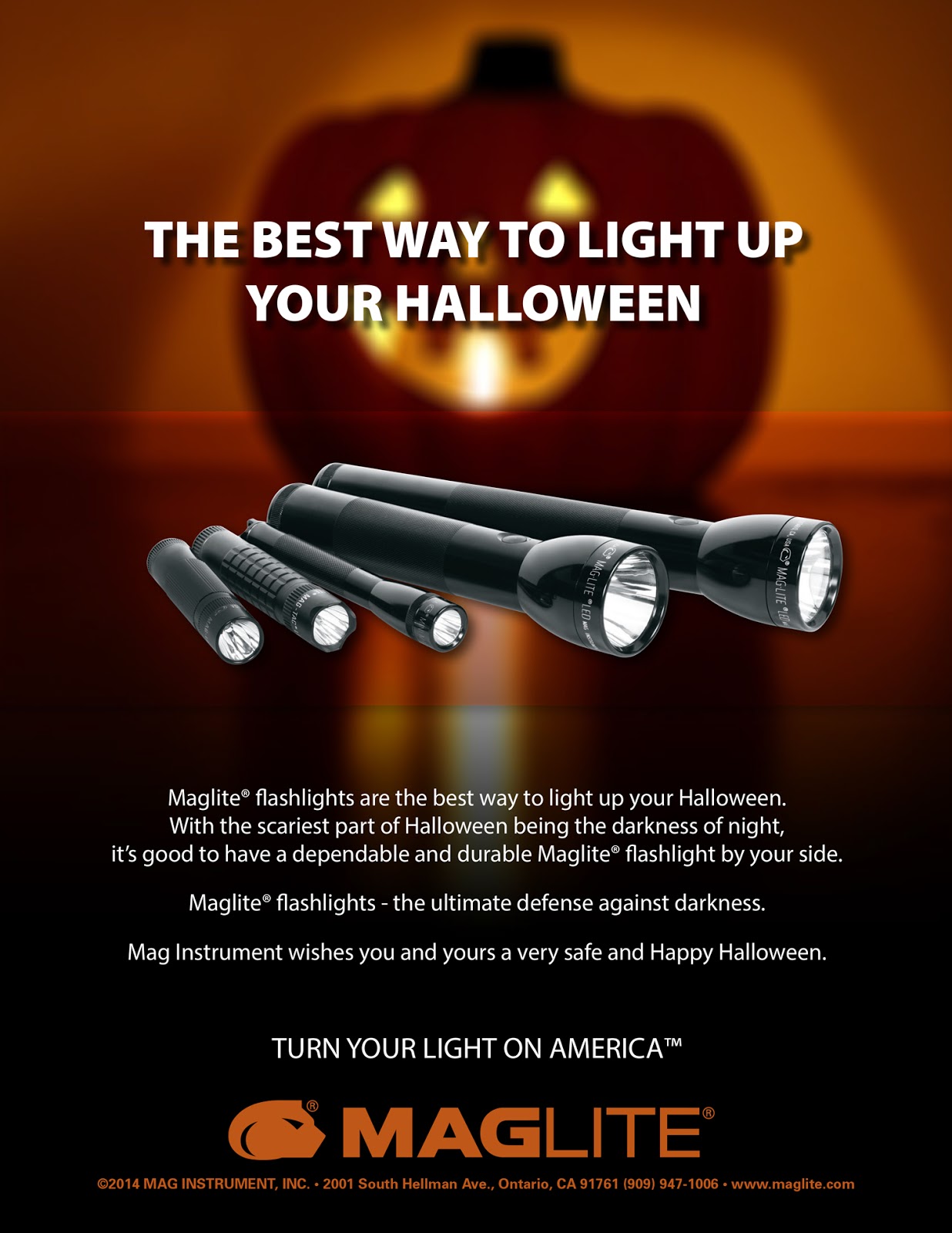
This is a current Maglite ad and uses their 1992 to Present Panther logo. This one usually runs in magazines and online around Halloween.
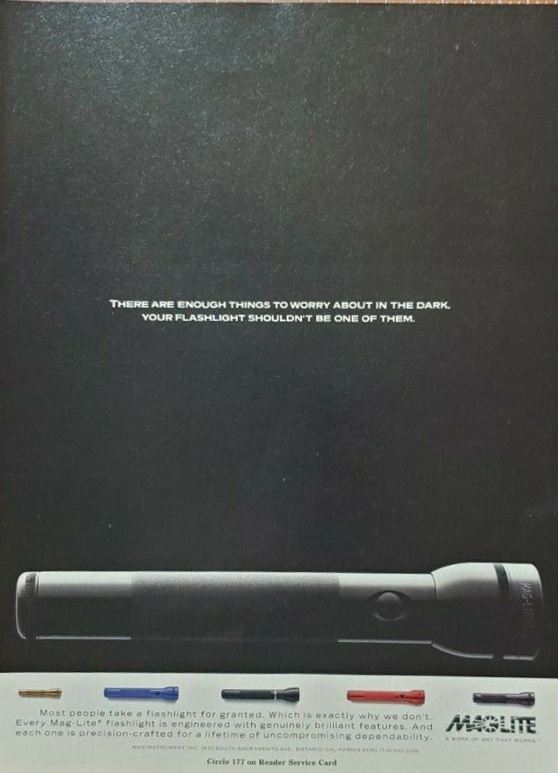
This is a very nice, early 2 page ad. It stresses that if Maglites are good enough for first responders they're good enough for most other uses too!
This ad is from the same time frame, around 1990 and is simple yet effective.
This ad is geared towards firefighters.
This ad is from Mag's very early days and uses their original logo. It advertises both their standard D cell light and the rechargeable Mag Charger.
If you spot any cool ads please drop me a line. I'd love to see them and I'll add more here in the future. Enjoy!!
As always I'm looking to buy Vari-Beams and Vintage/Rare Mags. Please let me know if you have any, top dollar paid.
Thursday, June 22, 2017
1990 and 1991 Transitional Maglites
Summary: In 1990 Maglite started to modernize their lights. This marked the end of the vintage Maglite era and the lights started to look more like the ones produced today.
Since 1979 Mag Instrument has been dedicated to finding ways to cut costs through manufacturing efficiencies instead of raising prices on their lights. Throughout the 1980s Maglites remained largely unchanged except for minor cosmetic differences. That changed in 1990. By 1992 the light's design was completely overhauled into the flashlight that's currently available today. In this post I'll discuss the 1990 and 1991 model lights. Most collectors refer to these as "transitional" models. Before I start it should be noted at all parts interchange between the 1991 and prior models even though the aesthetics changed slightly. This is not the case with 1992 and later lights where most parts will not interchange. Shown below is a 1991 Red Transitional 5D and a 1983 Black Vintage 5D. I'll discuss the differences shortly.
One of the changes that started in early 1990 was that the light's grip size was reduced. The grip size was reduced due to the fact that the grip near the end of the flashlight went largely unused as most users held the light near the switch or in the middle for a better balance point. The decision to reduce the grip saved on production time and tooling costs. Grip sizes were reduced according to the table below and the grip length was standardized to it's currently available length. Also shown below is a picture comparing two 3Ds. The top one is a vintage light that is an example of the 1989 and prior models and the bottom one is a 1990 that is a good example of 1990 and 1991 transitional lights. This picture show the overall reduced grip length. This change makes it very easy to spot the older lights on everyone's favorite auction site or in photos. Along with the bezel style it is a very useful tool in determining the age of a Maglite without knowing the serial number.
The bezel also changed. Like the Mini Maglites I covered earlier the bezel on the original models was stamped and the stamping was then filled in with white paint. Over time the white paint would sometimes wear away and the bezel stamping sometimes produced quality control issues. The laser etching, like the grip size change, reduced production time and although it was a large capital investment at the time the overall production cost was again reduced. Shown below is a picture of the difference between a stamped bezel on the pre 1990 models and a laser etched bezel of a 1990 light. The light on the left in both pictures is a laser etched bezel and the light on the right in both pictures is a stamped bezel. It's much easier to tell these apart in person because the laser etched bezels are smooth whereas the stamped bezels are indented and there is a groove for each letter.
In addition the switch style was also changed. Up until 1989 the switches used an aluminum retaining ring that screwed into the inside diameter of the light and held the switch in place. Starting in 1990 Mag Instrument changed this to a plastic retaining ring and it is now the only style available when ordering replacement switches for older style lights. I've detailed the benefits of this change in my post on removing stuck retaining rings. I do have a large collection of NOS (new old stock) metal retaining ring switches that I use for restorations so I can use the correct switch for the light being restored though. Shown below is a picture from that thread showing the difference between the switches. The older style switch is on the left and the newer style switch is on the right.
These "transitional" lights kept the same barrel size and non-letter serials as the pre 1990 lights. In 1992 the Maglite was completely re-designed into the model that's available today. Details on those changes can be found here. Most collectors regard the 1991 models as the last year of vintage Maglites and some even regard 1989 as the last year. I have several "transitional" Maglites but they are not as collectible as earlier lights. In fact most folks confuse these with the 1992+ "Panther" Maglites because they look so similar. I enjoy these lights because they still have the larger barrel even though they may be some of the least collectible Maglites.
Colors were very limited on these lights. This was mainly due to the fact that Mag Instrument was starting to modernize their facility and starting to build new tooling and assembly lines for the switch over to the redesigned lights in 1992. I've only seen these in black, red, blue, and silver. Serial numbers are going to be around the values listed in the table below as I have examples of each D cell transitional model and they were only produced for 2 years.
It is interesting to note that these serial numbers are also the production numbers of each model D cell up until 1991. So, in around a decade 4,000,000 3D Cells were produced. This is a good example of how popular, or unpopular, certain models are. I've always been curious as to why Maglite produces a 5D seeing how close in length they are to a 6D and 4D and how unpopular they are. I posted a D Cell Quick Dating Guide that shows round about serial numbers for each model and the above table can also be used to guesstimate the age of your light. Production numbers were low in 1979 and 1980 but were pretty constant throughout the rest of the 80s. Of course, Maglite can tell you the exact date your light was manufactured if you send them an info request on their web site. It's also interesting to note that in the 90s some model Maglites sold in these numbers in a single year. For example 3Ds would easily sell 2,000,000 a year or more in the late 90s. This puts into perspective how rare the 1991 and prior lights really are.
As always I'm looking to buy Vari-Beams and Vintage/Rare Mags. Please let me know if you have any, top dollar paid.
Since 1979 Mag Instrument has been dedicated to finding ways to cut costs through manufacturing efficiencies instead of raising prices on their lights. Throughout the 1980s Maglites remained largely unchanged except for minor cosmetic differences. That changed in 1990. By 1992 the light's design was completely overhauled into the flashlight that's currently available today. In this post I'll discuss the 1990 and 1991 model lights. Most collectors refer to these as "transitional" models. Before I start it should be noted at all parts interchange between the 1991 and prior models even though the aesthetics changed slightly. This is not the case with 1992 and later lights where most parts will not interchange. Shown below is a 1991 Red Transitional 5D and a 1983 Black Vintage 5D. I'll discuss the differences shortly.
One of the changes that started in early 1990 was that the light's grip size was reduced. The grip size was reduced due to the fact that the grip near the end of the flashlight went largely unused as most users held the light near the switch or in the middle for a better balance point. The decision to reduce the grip saved on production time and tooling costs. Grip sizes were reduced according to the table below and the grip length was standardized to it's currently available length. Also shown below is a picture comparing two 3Ds. The top one is a vintage light that is an example of the 1989 and prior models and the bottom one is a 1990 that is a good example of 1990 and 1991 transitional lights. This picture show the overall reduced grip length. This change makes it very easy to spot the older lights on everyone's favorite auction site or in photos. Along with the bezel style it is a very useful tool in determining the age of a Maglite without knowing the serial number.
In addition the switch style was also changed. Up until 1989 the switches used an aluminum retaining ring that screwed into the inside diameter of the light and held the switch in place. Starting in 1990 Mag Instrument changed this to a plastic retaining ring and it is now the only style available when ordering replacement switches for older style lights. I've detailed the benefits of this change in my post on removing stuck retaining rings. I do have a large collection of NOS (new old stock) metal retaining ring switches that I use for restorations so I can use the correct switch for the light being restored though. Shown below is a picture from that thread showing the difference between the switches. The older style switch is on the left and the newer style switch is on the right.
These "transitional" lights kept the same barrel size and non-letter serials as the pre 1990 lights. In 1992 the Maglite was completely re-designed into the model that's available today. Details on those changes can be found here. Most collectors regard the 1991 models as the last year of vintage Maglites and some even regard 1989 as the last year. I have several "transitional" Maglites but they are not as collectible as earlier lights. In fact most folks confuse these with the 1992+ "Panther" Maglites because they look so similar. I enjoy these lights because they still have the larger barrel even though they may be some of the least collectible Maglites.
Colors were very limited on these lights. This was mainly due to the fact that Mag Instrument was starting to modernize their facility and starting to build new tooling and assembly lines for the switch over to the redesigned lights in 1992. I've only seen these in black, red, blue, and silver. Serial numbers are going to be around the values listed in the table below as I have examples of each D cell transitional model and they were only produced for 2 years.
It is interesting to note that these serial numbers are also the production numbers of each model D cell up until 1991. So, in around a decade 4,000,000 3D Cells were produced. This is a good example of how popular, or unpopular, certain models are. I've always been curious as to why Maglite produces a 5D seeing how close in length they are to a 6D and 4D and how unpopular they are. I posted a D Cell Quick Dating Guide that shows round about serial numbers for each model and the above table can also be used to guesstimate the age of your light. Production numbers were low in 1979 and 1980 but were pretty constant throughout the rest of the 80s. Of course, Maglite can tell you the exact date your light was manufactured if you send them an info request on their web site. It's also interesting to note that in the 90s some model Maglites sold in these numbers in a single year. For example 3Ds would easily sell 2,000,000 a year or more in the late 90s. This puts into perspective how rare the 1991 and prior lights really are.
As always I'm looking to buy Vari-Beams and Vintage/Rare Mags. Please let me know if you have any, top dollar paid.
Tuesday, June 20, 2017
2001 3D 9/11 Search and Rescue Lights
Summary: These lights were produced as a donation to the 9/11 rescue effort by Maglite. They were handed out to first responders at ground zero and are extremely rare today because most were lost in the cleanup effort. They are one of 5 lights Maglite has produced as giveaways for historical events.
I noticed I've been posting a lot of old Maglite history but no lights lately. I'm about half way through my collection so here's a really interesting one with a bit of American history. These are the newer style, Panther light which I normally don't collect but these are so rare and have such a large place in American history I could not pass them up.
September 11th was one of the darkest days for America. It is right up there with Pearl Harbor and the Kennedy assassination. Those that were alive on those days will always remember exactly where they were when they heard the news. I am originally from New Jersey, just 20 miles west of New York City, so 9/11 hit close to home for me. I knew several buddies that were impacted first hand and I also knew some heroic folks who were involved in the search and rescue effort. I think it will remain for some time one of the worst days on record but also stand to a testament of the American spirit.
In true American fashion Mag Instrument donated 3,000 Maglites to the 9/11 search and rescue effort. These were all 3D models and were donated in a variety of colors but as far as I know were all 3Ds. The two below are finished in purple and standard black although the standard black light shown below has no knurling. These no knurling model were produced very sparingly in the early 2000s and are tough to come by today. Mag Instrument has made several giveaway/donation lights and this was the only D cell one that I know of. These were passed out to emergency responders in the days after the 9/11 attacks and as the wording implies were not for sale. I haven't seen many of these so I don't imagine that many were saved during the 9/11 cleanup.
I was looking for one of these for a while but wasn't sure really what all to look for. Mag Instrument makes mention to them on their site but doesn't show much info. I could see they had a laser etching by the tail cap but until I got this light I wasn't sure if they were all printed that way or if it was just the one on the website. The image from Mag's website is below and shows one finished in a prototype, never released, rose gold finish. I've heard of some of these being distributed for donation as well.
If anyone else has one of these please contact me as there is something on this light that I think is different from other standard 3Ds but I just want to confirm. These are all going to be around a ~29,000,000 serial which puts them right in the 2001 production range. They are not going to be sequential because I believe they are all different finishes.
As always I'm looking to buy Vari-Beams and Vintage/Rare Mags. Please let me know if you have any, top dollar paid.
I noticed I've been posting a lot of old Maglite history but no lights lately. I'm about half way through my collection so here's a really interesting one with a bit of American history. These are the newer style, Panther light which I normally don't collect but these are so rare and have such a large place in American history I could not pass them up.
September 11th was one of the darkest days for America. It is right up there with Pearl Harbor and the Kennedy assassination. Those that were alive on those days will always remember exactly where they were when they heard the news. I am originally from New Jersey, just 20 miles west of New York City, so 9/11 hit close to home for me. I knew several buddies that were impacted first hand and I also knew some heroic folks who were involved in the search and rescue effort. I think it will remain for some time one of the worst days on record but also stand to a testament of the American spirit.
In true American fashion Mag Instrument donated 3,000 Maglites to the 9/11 search and rescue effort. These were all 3D models and were donated in a variety of colors but as far as I know were all 3Ds. The two below are finished in purple and standard black although the standard black light shown below has no knurling. These no knurling model were produced very sparingly in the early 2000s and are tough to come by today. Mag Instrument has made several giveaway/donation lights and this was the only D cell one that I know of. These were passed out to emergency responders in the days after the 9/11 attacks and as the wording implies were not for sale. I haven't seen many of these so I don't imagine that many were saved during the 9/11 cleanup.
The other official donation and giveaway lights were the George HW Bush 1989 inaugural Mini Maglites, George W Bush 2001 and 2005 Mini Maglites and the 1994 Lillehammer Winter Olympics Mini Maglites. Maglite lists several other donation lights on their website but to the best of my knowledge I don't believe these had any special inscriptions or were any different than the normal production lights.
I was looking for one of these for a while but wasn't sure really what all to look for. Mag Instrument makes mention to them on their site but doesn't show much info. I could see they had a laser etching by the tail cap but until I got this light I wasn't sure if they were all printed that way or if it was just the one on the website. The image from Mag's website is below and shows one finished in a prototype, never released, rose gold finish. I've heard of some of these being distributed for donation as well.
If anyone else has one of these please contact me as there is something on this light that I think is different from other standard 3Ds but I just want to confirm. These are all going to be around a ~29,000,000 serial which puts them right in the 2001 production range. They are not going to be sequential because I believe they are all different finishes.
As always I'm looking to buy Vari-Beams and Vintage/Rare Mags. Please let me know if you have any, top dollar paid.
Sunday, June 18, 2017
Stuck Batteries
This is part of a series of posts I've written about common Maglite repairs. I've also covered the following topics:
Removing Battery Corrosion and Straightening Bent Lights
Stuck End Caps
Stuck Retaining Rings
Switch Removal and Stuck Switches
Switch Disassembly and Repair
Disclaimer: I'll start out by saying that these repairs are tedious and challenging. It is very rewarding to make an old Maglite light again though. If you have a special light and don't feel up to the challenge I do restorations and custom work on most vintage flashlights. My contact info is at the right side of the page.
One of the most common problems that plagues vintage flashlights is stuck or frozen batteries. This is caused by alkaline batteries being left inside a flashlight long after their expiration date. Most flashlights see only occasional use and as such the alkaline cell corrodes through it's outer shell before the energy is depleted. Usually the user will turn on the light one day to find that it doesn't light and one or more cells is stuck in the light.
Have no fear, there is a solution! I've always been able to remove stuck batteries on every light I've worked on. It is just a matter of persistence and patience. Some may find that it is easier to purchase a new light. This is likely true for most ordinary users. However, some vintage lights are literally one of a kind and to me at least they are worth returning to running order.
Shown below is a 1st generation 5C cell Kel-Lite from the early 70s. While this isn't a Maglite the process works the same for a Maglite although a Maglite switch is located inside the barrel vs. on the exterior of this Kel-Lite. I have some info on Kel-Lites on my new blog. On a Maglite the switch must be removed from the front (reflector side) of the barrel. This can be accomplished by unscrewing the retaining ring on an older style, non-letter serial or by removing the snap ring on the newer, panther style lights. More info is available in my post here about removing switches if they are stuck.
Removing Battery Corrosion and Straightening Bent Lights
Stuck End Caps
Stuck Retaining Rings
Switch Removal and Stuck Switches
Switch Disassembly and Repair
Disclaimer: I'll start out by saying that these repairs are tedious and challenging. It is very rewarding to make an old Maglite light again though. If you have a special light and don't feel up to the challenge I do restorations and custom work on most vintage flashlights. My contact info is at the right side of the page.
____________________________________________________________
One of the most common problems that plagues vintage flashlights is stuck or frozen batteries. This is caused by alkaline batteries being left inside a flashlight long after their expiration date. Most flashlights see only occasional use and as such the alkaline cell corrodes through it's outer shell before the energy is depleted. Usually the user will turn on the light one day to find that it doesn't light and one or more cells is stuck in the light.
Have no fear, there is a solution! I've always been able to remove stuck batteries on every light I've worked on. It is just a matter of persistence and patience. Some may find that it is easier to purchase a new light. This is likely true for most ordinary users. However, some vintage lights are literally one of a kind and to me at least they are worth returning to running order.
Shown below is a 1st generation 5C cell Kel-Lite from the early 70s. While this isn't a Maglite the process works the same for a Maglite although a Maglite switch is located inside the barrel vs. on the exterior of this Kel-Lite. I have some info on Kel-Lites on my new blog. On a Maglite the switch must be removed from the front (reflector side) of the barrel. This can be accomplished by unscrewing the retaining ring on an older style, non-letter serial or by removing the snap ring on the newer, panther style lights. More info is available in my post here about removing switches if they are stuck.
For the first step I'll clean out any loose alkaline that is inside the light with some warm water and a tooth brush. Next, just as I detailed in my post about removing corrosion, vinegar does a heck of a job at neutralizing the alkaline base and freeing the cells from the light. I use a 1 liter soda bottle with the top cut off to make up a bath for the light as shown below.
The trick here is letting the light soak and frequently changing the vinegar. What I usually do is let the light soak for a week, try to remove the batteries as per the instructions below and then soak the light again. It does help to change the vinegar bath every few days and remove any alkaline that has fallen out. Gently tapping the light while it is soaking every day or so helps the vinegar to work it's way in between the cells and barrel. Shown below is what my vinegar bath looked like after a couple days with alkaline floating it it.
Now it's time to try to remove the batteries. If this step doesn't work without a ton of effort try soaking the light longer. For serious offenders lemon juice may be alternated with vinegar to try to free up the cells easier. Different types of chemistry on the cells respond to either vinegar or lemon juice better but I don't quite know why.
First thing's first. You'll need some sort of dowel or punch to put force on the batteries. I used a 1/2" copper pipe but I've also used brass punches, wooden dowels and small steel rods. I prefer something softer so I know how much force I'm exerting. Also, you'll want to set the light on a piece of wood so it is not damaged. Shown below is how this should look.
Next, take a hammer, I like to use a rubber mallet, and pound the offending cells into exile from the barrel. If they don't budge or so much force is exerted that the light is in danger of being damaged try soaking it longer. Again, you want to make sure the light is on a sturdy but wooden surface during hammering otherwise the barrel end will mushroom ruining the threads and rendering the light useless, Obviously you'll want to hold or secure the light during hammering. Shown below is the aftermath of the removal and the hammer I use.
And the offending cells. Note these expired in 2009, 8 years prior to this post. Cells usually have a shelf life of 10 years so these were likely installed in the light in 1999.
Here is a shot of the inside diameter of the light. You'll need to continue to my post about post about removing corrosion to finish up the light and get it back into 100% working shape again. I'll post some pics of this finished light on my new blog soon. Best of luck!
If you're interested in seeing the rest of this restoration as well as the finished light. Please cruise on over to my other blog or the direct link to this post is: http://otherflashlights.blogspot.com/search/label/Kel-Lite%20Repair
As always I'm looking to buy Vari-Beams and Vintage/Rare Mags. Please let me know if you have any, top dollar paid.
Subscribe to:
Posts (Atom)


.jpg)