Check out my other flashlight blog at: http://otherflashlights.blogspot.com/ More content coming soon.

Saturday, June 10, 2017

1981 to 1989 7C Lights

Summary: 7 cell Maglites are some of the most desired among collectors. However, they didn't sell well when originally released due to their size. Maglite started making C cell lights in 1981, almost 2 years after D cells.

7D and 7C cells are among some of the rarest lights Mag Instrument has produced. C cells were introduced after D cell lights in 1981. C cells have been far less popular over the years mainly due to the fact that they are close to the same physical size but with less battery capacity. Some prefer the smaller diameter barrel of C cells though especially in the civilian market. The 7 cell models were mainly intended for law enforcement but many departments started to frown on larger "more menacing" lights in the wake of several police brutality controversies in the mid 80s and because of the increased brightness of smaller more carry friendly lights.

7 cell lights, both C and D, did not sell well and Mag Instrument discontinued them after only a few years. 7C cells were discontinued in 1989. 5C and 6C cells were discontinued in 2003.  In the 10 years or so they were produced they seem to have sold only 4,000 a year. By 1989 3Ds, traditionally Maglite's most popular model, were at serial # 3,000,000, and sold about 300,000 a year. In the 90s 3Ds easily sold 2,000,000+ units a year. It's no surprise that with such low sales number that the 7C was discontinued. C cells overall have always sold poorly compared to D cells.

The highest serials on 7Cs I've seen are ~40,000 from when the 7Cs were discontinued in 1989. I've also never seen a 7C with a Panther bezel which came out in 1992 or laser etched bezel which came out in 1990 so this makes sense. I have a C Cell Quick Dating Guide for those interested in these differences throughout the years. Early models are typically worth more than later models and condition is a big factor in cost also. A good condition early light can bring up to $250 with later, more well used models selling for $150 or more.

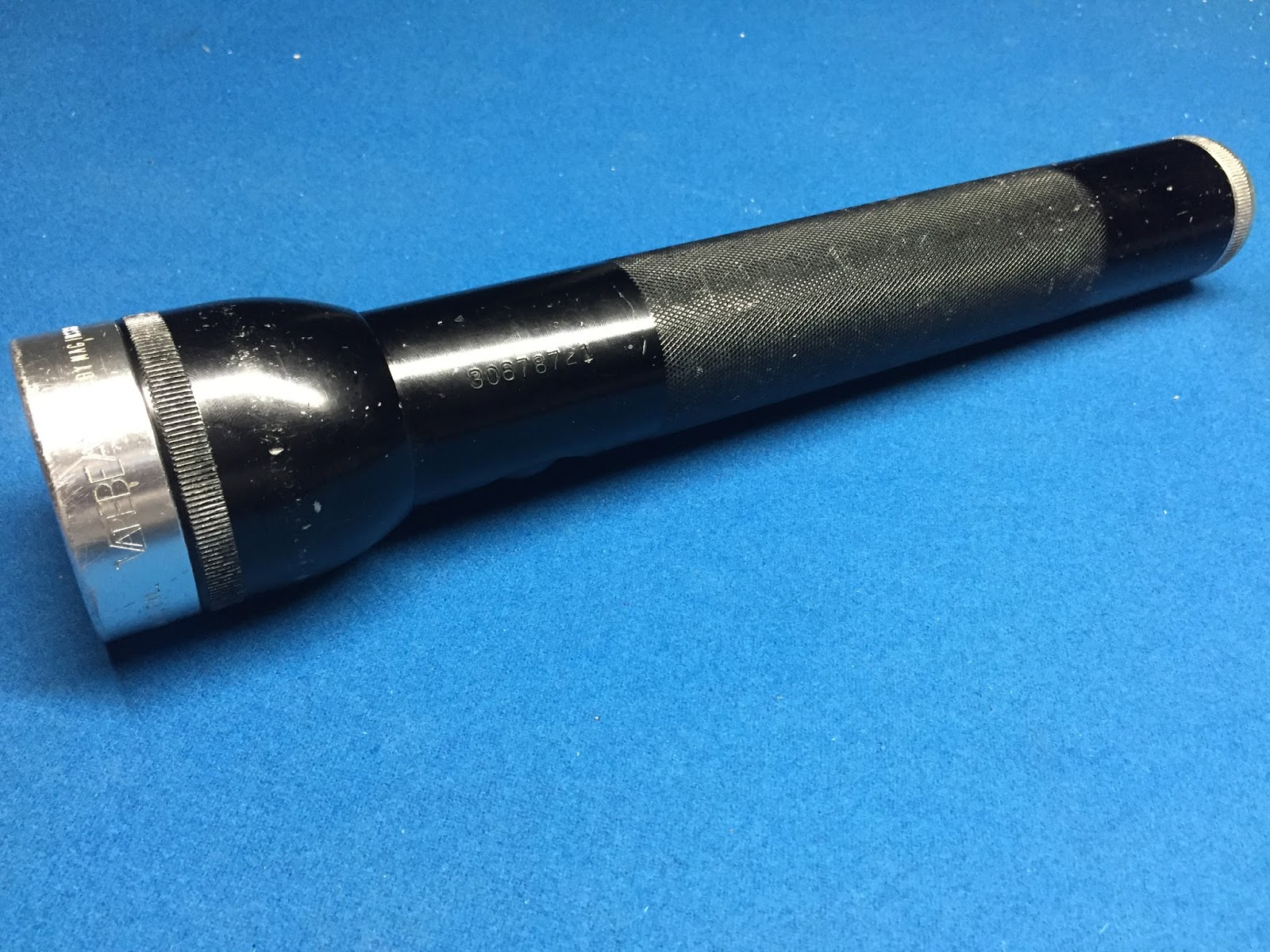
Shown below is my collection of 7C lights and I'll go through each of them in detail.


These 2 7Cs are the earliest in my collection. Both are pretty well used. The really beat up one is a 1982 7C, it is a ~6,000 serial. It came from a collector in the UK who purchased it from eBay. I personally prefer used lights over NIB ones although I do own both. The used lights more so tell a story and are each unique with the way the finish fades and the nicks and scratches that add up. From what I hear these longer lights were more popular in Europe where most weapons are banned. These could still be purchased for defense legally. The other light is a 1984 ~12,000 serial and was purchased from an estate sale but unfortunately I didn't get many details on it. These lights have the flat style end cap produced only during the first few years of production starting in 1981 and up until about 1986 or so. The 6,000 serial light is likely from the second batch of 7Cs. Starting around 1987 C cell Maglites came with a longer end cap that could store a bulb. I have an example of this too.


I've also included a photo for comparison purposes next to a red 1990 6D. Starting in 1990 several changes were implemented to the D cell Maglites. Note that the 7C cell is actually an inch or so shorter than a 6D cell.


This is a later 7C that I picked up on everyone's favorite auction site. This light, like most online, had very few details but I could tell it was a long C cell. 5, 6, and 7 C cells are all fairly rare and have each been going for $100 plus when properly described and the auction ends at night. So, I snatched it up at $30 shipped to find out a couple days later when it arrived it was another 7C. It is a ~38,000 serial and Maglite dated it for me at 1988.


This 7C came from one of the large auction site retailers that liquidates estate finds and storage lockers so unfortunately I don't have any story behind it but it appears to be in pretty good shape. It has a later style 6D bi-pin bulb installed. In a previous post I wrote about PR based bulb specs and showed some old Mag Inserts. From this a PR20 is the correct choice for 7 cells. Mag Instrument no longer produces their own 7 cell bulb and PR20s aren't easily found in stores so a lot of folks use a 6 cell bulb. The 6 cell bulb works just fine but has a marginally shorter life. Shown below is the difference in end caps that I mentioned earlier. The newer style "store-a-bulb" end cap is shown on the top and the older flat end cap is shown on the bottom.


This last 7C is a very special one. It was featured in Maglite displays at early trade shows and in Maglite ads. Unfortunately it is no longer water resistant as it had holes drilled it it for display purposes but otherwise it is in like new condition. I was able to purchase this light from an ex-Maglite employee. Other than its interesting history it is a run of the mill ~14,000 serial early style 7C. I display it with the rest of my Maglites but I'm able to hang it up through the original display holes so it's a very unique addition to my collection.


As always I'm looking to buy Vari-Beams and Vintage/Rare Mags. Please let me know if you have any, top dollar paid.

Wednesday, June 7, 2017

1980 to 1985 Vari-Beams

Summary: Vari-Beams were produced between 1980 and 1985 and were intended to capture more of the consumer sales instead of law enforcement. The lights were brightly colored with blue barrels and heads and silver end caps and bezels so they would be difficult to lose in a dark area. Consumers ultimately preferred the all black "cop" lights and the Vari-Beams were discontinued. They are highly collectible today.

In a few earlier posts I made reference to Mag Instrument Vari-Beams. I guess I should probably take the time now to make a post detailing the history of these unique flashlights. While some may think they look like an odd Maglite with their blue bodies and silver bezels and end caps they actually have an interesting story. As I've detailed in an earlier post the Maglite was a joint effort by Tony Maglica and Don Keller. While Tony gets most of the credit today Don Keller was instrumental in the success of the Maglite.


Don was previously involved in several successful flashlight companies including Kel-Lite, which was named after him, Pro Light and Bianchi. When Don joined Mag Instrument in 1979 he brought with him more than a decade of manufacturing and marketing expertise as well as many industry contacts. Don and Tony both knew that if the company were to be a success they would have to reach more than just the saturated law enforcement market and they would have to crack into the household and trade markets for durable flashlights. This had been attempted but not previously been achieved to any successful extent.

Mag Instrument first concentrated on the core market of law enforcement and was successful early on. The reliable push button switch and focusable head was seen as an improvement over earlier external slide switches. The over all feel and durability of the flashlight was also very high. In 1980 Don, heading up marketing, took this product to many large retailers at the time including both Costco and K-Mart. The retailers were interested but several asked for a product that was different from the flashlights police officers carried and wanted a light more similar to earlier, brightly colored flashlights that could be spotted easily in a dark or cluttered room.

The Vari-Beam was born as a result of Mag Instrument's marketing department. The basic product was identical to the Maglite with the exception of color and name. In 1980 Mag Instrument produced 2 though 5 D cell lights as Vari-Beams. These lights were pulled from stock batches of Maglites, anodized blue and used a Vari-Beam logo'd bezel and polished aluminum end cap. Very few had the "Paten Pending" barrel. Most were made after the patent was approved in 1981. Shown below is my 1980 4D "Paten Pending" Vari-Beam with a very low serial of ~50,000.


4Ds and 5Ds were dropped around 1982 due to the slower sales of larger lights in general. As such, they are some of the rarest today. I have also seen a single 6D Vari-Beam from this time frame (~26,000 serial) that may have come from a very small batch or was customized by a dealer. Shown below is my 1981 5D. I did a full restoration of this light. I've included some before pics to show how rough it was. The light is fully operational and in tip-top shape now albeit with some good wear, err character.


C cell production started in 1981 and C cells were also produced as Vari-Beams too. Only a handful of the lowest serials are stamped "Paten Pending" as production started right around the time the patent was approved. 2 through 5 C cells were available during this time. C cell lights always sold poorly compared to D cells. C cell Vari-Beams were dropped around late 1982. As such, you'll never see a Vari-Beam with an extended end cap and all C cell Vari-Beams are going to be very low serials. Shown below is a ~14,000 serial 1982 4C Vari-Beam.


In 1983 due to slow Vari-Beam sales Mag Instrument tried to differentiate the Vari-Beams further. A new Vari-Beam was introduced. Collectors usually refer to these as the "intermediate" Vari-Beam. Mag Instrument started numbering the bodies with separate serial numbers from their Maglite counterparts starting at 1 and going up to 25,000 or so. Because of this Mag Instrument is not able to date these lights if you send them in a serial number and model. The grip was also changed to a Solitaire style vertical grip instead of the cross hatched knurling of the Maglites. These were produced in 2, 3 and 4 D cells. There may have also been 2 and 3 C cells too according to old packaging but I've never seen any in person.

Shown below are "intermediate" 1983 2D, 3D, and 4D Vari-Beams vs. standard 2D 3D, and 4D Vari-Beams. Production serials indicate about 25,000 3Ds were produced that year and likely the same amount of 2Ds. Note the 2D has a super low serial of 693. It is not as old as the serial would suggest though because of the separate serial numbering scheme. This is one of the lowest serial number lights I have but it is not the oldest. That distinction belongs to a 2D I covered in another post. The 4D I have is a bit of an anomaly. The knurl of the grip is much heavier and it does not have a separate serial but rather it's body was pulled from the standard Maglite production line. It is serial # 132,776 which dates to 1983. It's also the only intermediate 4D I've ever seen. My guess is that either it was a prototype or that it was part of an extremely small batch.


In 1984 the Intermediate style was discontinued as their expense was not justifiable vs. the small quantities being sold. During 1984 and 1985 standard 2 and 3D cell lights were again pulled from assembly lines and anodized blue to fulfill remaining orders. These were all around 700,000 serial 3Ds and would likely be a close serial number on the 2Ds.

In 1984 the Mini Maglite started production. Very small quantities of the Mini Maglite were produced as an AA Vari-Beam in 1985. I searched and searched for an AA Vari-Beam for a very long time and I was finally able to pry one from the grip of another large collector. As far as I can tell they were produced in 1985 to mark the end of the Vari-Beam run and either given away to employees and/or sold in very small quantities as a limited edition run. Based on the laser etched bezel, the R after the Vari-Beam logo and the end of the Vari-Beam run I was able to date this light to approximately 1985. It has the old narrower barrel, so many were likely traded back into Mag when AA batteries were up sized or were destroyed when batteries corroded in the barrel. It also has the vertical, Solitaire and Intermediate Vari-Beam knurling. This is the only one I've ever seen and I've only ever heard of one other.


Shown below is an older pic I took with a portion of my Vari-Beam collection along with a 1980 3D "Paten Pending" blue Maglite and first generation blue Mini Maglite. The anodizing is identical on blue lights and Vari-Beams as Mag Instrument used the same third party coater early on for all anodizing.


Vari-Beams were sold mainly through big box retailers and also through industrial supply outlets to trades. They were ultimately discontinued because consumers preferred the all black model carried by law enforcement. This is contrary to the original belief of the retailers.

It is interesting to note that Kel-Lite, under Norm Nelson, also tried to create a separate line of flashlights, the Stud-Lite, that was marketed to truckers during the late 70s. Unlike Maglite, Kel-Lite actually wanted to put out the Stud-Lite as Norm Nelson came from Per-Lux, a truck lighting manufacturer, and believed there was a market for flashlights there. Shown below are 2 - 3D Stud-Lites compared to 2 - 3D Vari-Beams. The Stud-Lites are shorter due to the external slide switch. Stud-Lites were produced in C and D cell versions in blue and silver and silver and black. I have a post with the history of Stud-Lites on my other blog.


So now to clear up some internet rumors. Mag Instrument only produced these lights in silver and blue. However, every once in a while a black and silver one will come up or some other color combination. The bezels and end caps can be interchanged between Vari-Beams and Maglites and this often occurred either by consumers after purchase or by distributors and retailers that wanted to clear out stock of sometimes unpopular blue Vari-Beams. Some retailers were also authorized service centers and they would put the Maglite bezels and end caps back into stock to use to repair a light later on. It is difficult to tell which black and silver Maglites were done by retailers and which were done by consumers. Shown below is an example of a black and silver 3C done by a dealer in order to help it sell. It is even in a Maglite package from the same time period. Also shown below is a well used ~670,000 serial black and silver 3D. This serial is from around 1986, after Vari-Beam production ended, so it was likely done by a dealer trying to clear out old stock.



Larger Vari-Beams, especially C cells ,are the rarest because larger lights were unpopular with consumers as were C cells. Intermediate Vari-Beams are also very rare due to their short production cycle. Vari-Beams had their own dedicated packaging and inserts. The box itself is identical to the typical early Maglite cardboard display box but is blue and has the Vari-Beam logo on it. Shown below are the 2 NIB (new in box) Vari-Beams I have compared with a standard 1980 to 1984 Maglite display box. The box also has the abandoned head size designation on it too. The insert is also shown below and it is identical to early Maglite inserts except all instances of Maglite have been replaced by Vari-Beam. During 1985 Mag Instrument used a clear package with the Vari-Beam logo similar to the Maglite ones from that time. I've heard that Mag may have produced some intermediate style 2 and 3 C cells but I can't confirm that. I often see Vari-Beam misspelled as Varibeam, Varebeam, or Vare-Beam due to the font used on the bezel. The Trademark for the light has it listed as Vari-Beam as well as old catalogs.


I have a mostly complete collection of Vari-Beams. I'm only missing a 3C. C cells are pretty rare but I have hope I'll run across one in the future. I have a few doubles, 3 intermediate Vari-Beams, and a few more black and silver dealer model as well that aren't pictured here. These lights still pop up on the large auction site every couple of months or so and they can range in price from $40 to $100 depending on condition and demand. If anyone has any Vari-Beams or info I'd love to see some pics and hear from ya.


As always I'm looking to buy Vari-Beams and Vintage/Rare Mags. Please let me know if you have any, top dollar paid.

Sunday, June 4, 2017

1988 Marquis and Solitaire and Solitaire History

Summary: When the Solitaire came out in 1988 it was originally called the Marquis. Only a handful of Marquis lights were produced before the name was changed. Retailers preferred the Solitaire name more.

The Maglite Solitaire debuted in 1988 as a single AAA light designed so that women could carry it easily in a purse. Maglite developed and released an AAA Mini Maglite earlier that year but Tony Maglica's partner Claire pushed the company to produce a light geared more towards women and less towards industry and law enforcement. By this time Maglite's sales were changing from predominantly law enforcement to mostly civilian and trades.

Originally the light was to be called a Marquis. A small run of Marquis were produced during May of 1988 and were sent to retailers. However even before the light was issued the name was very unpopular with Maglite's marketing team as there were several other products already named Marquis. From the beginning Maglite's marketing team wanted the light to be called the Solitaire but the Marquis name was put on the light at insistence of Claire.

When the lights reached retailers the same complaints were received about other products with the same name. Maglite's marketing team won this argument and the light was renamed the Solitaire starting in July of 1988. Early Solitaires, like the one below, carry the TM designation after Solitaire. The registered trademark was not approved until March of 1989 and the R with a circle was then placed after Solitaire. The TM Solitaires were only produced for 8 months. There were a couple more bezel styles and the Panther logo was introduced onto the light in 1992. LEDs came later.

A story being circulated online is that Maglite could not use the Marquis name because of a trademark disputes. I have found nothing to support this. In fact, the Marquis trademark was approved in March 1989 and lapsed in 1995 due to dis-use because the light was no longer being produced.

Technical differences are very minor throughout the production run of the Marquis and Solitaire. Early on only black and silver were available. Now many colors are available. The Mfg. by Mag Instrument wording also changed a few times with different abbreviations for California used and then an eventual switch to a single line of text.

Maglite Marquis are one of the rarest Maglites. I only personally know of a handful that exist, mostly all in black and 1 silver. Production lasted only 1 month and most folks likely disposed of the lights if the batteries leaked inside of them or after they were carried for a number of years so it's not likely many more are out there. I was lucky enough to come across 2 in my years of collecting. One was acquired from another collector who purchased it from the original owner in the UK. The UK owner bought it at a department store on a business trip to California and then stored it without batteries in a drawer before selling it a few years ago. The second I found with a lot of lights that I bought from an estate sale and also appears unused. Like many doubles I hope to trade it for a rare light that I don't have yet.

Shown below are my Marquis and TM bezel Solitaire. These are two of the smallest and rarest lights in my collection. The Marquis is on the top and the Solitaire is on the bottom. These early Solitaires and Marquis also came with a Mag Instrument token which is shown below too.


As always I'm looking to buy Vari-Beams and Vintage/Rare Mags. Please let me know if you have any, top dollar paid.

Friday, June 2, 2017

Early Maglite Package Inserts

After my bulb spec and non-letter serial colors posts I noticed there was some interest in the old inserts that came in Maglite packaging. I have 3 shown below. They are from the earliest D cells, the earliest C cells and then starting in 1982 or so the inserts were combined to show D and C cells.

The first insert below is from a 1979 light, specifically the earliest Maglite I know to exist.. This insert is in very rough shape as not many exist from this time and it was not printed on as heavy stock as were later inserts. It makes reference to a large head size which was never produced. It also details using vinegar to clean battery corrosion and warns against leaving batteries in the light past their expiration date. The parts lists shows 2 through 7 cell options for the bodies. 7Ds ran for only a very short time and I'll do a post on them in the future.


The one below, on green stock, is from a 1981 2 C Cell. This insert would have run for the first year or so until both parts list were combined into a single format shown below. The reason for the different inserts is because D cell lights were introduced in 1979 whereas C cell lights were introduced in 1981.


I have a couple of interesting notes on here. The blue 2C - 4C lights that are listed likely do exist as I found one recently. It's a 4C but I've never actually seen the 2C and 3C versions. The Sil/Blue option that's listed is for the Vari-Beams. These lights were actually available in 2 through 5 cells in both C and D so I'm not sure why they weren't listed here unless this parts list is for the intermediate style where the grip was cut like a solitaire and the lights were numbered separate from the Maglite line. I don't know if the intermediate Vari-Beams were ever produced in C cells as there just aren't that many examples of even the D cells around. Maglite was still using their old address on the warranty info. They are now located on South Hellman Ave in Ontario although Mag Instrument still has an office at South Sacramento Ave. Mag also stopped selling switch parts and now only sells the full switch assembly. Shown below is a Vari-Beam insert which is identical except that each instance of Maglite has been replaced by Vari-Beam.


The white insert below is from 1983 and was used all the way until 1991. This insert combined the C and D cell parts list into one list so the same insert could be used for both C and D cells.


Some interesting notes on here are that the 7D cell barrel part has been removed but the 7C barrel still is left on. This is because 7Cs continued production until 1989 where as 7Ds were only made until 1982. Silver also shows as not being available for order in Ds or Cs but I'm not sure why. I have a silver 2D and a silver 3C light from around this time. I'm guessing it's because Maglite produced these sparingly, possibly as test runs, and didn't stock parts for them. Some C cell models still show as being available in blue but again I've never seen these.

As always I'm looking to buy Vari-Beams and Vintage/Rare Mags. Please let me know if you have any, top dollar paid.